Machinery Regulation (EU) 2023/1230: the transition is now
Every date that mattered for the new Machinery Regulation has already gone by. The one still ahead is 20 January 2027, and we're in the final stretch: under six months to go. From that date, Regulation (EU) 2023/1230 is the only route to CE marking for machinery placed on the EU market. No grace period, no parallel option.
That can feel abrupt if you've only just heard about it, but it isn't sudden. The Regulation has been in force since 2023. What changes on 20 January 2027 is that Directive 2006/42/EC stops being a valid alternative.
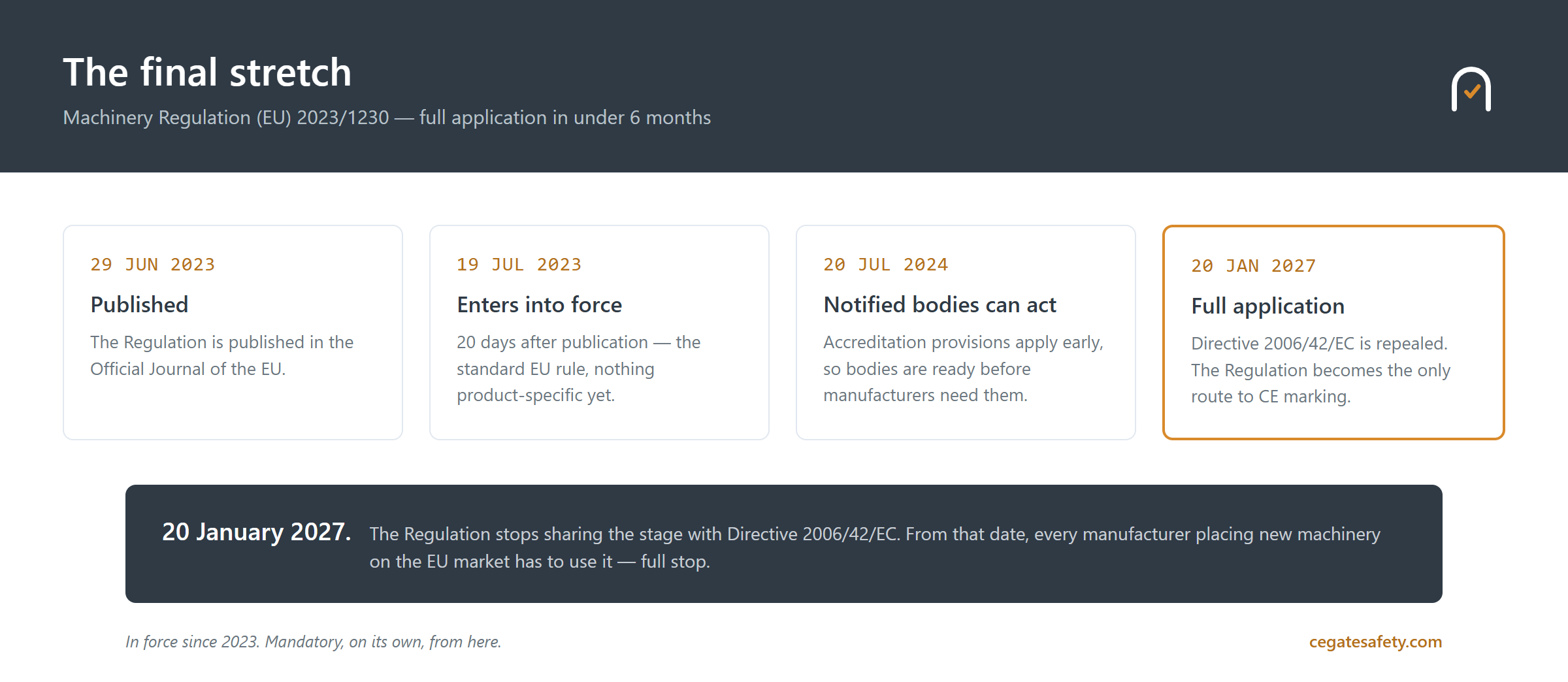
The dates, and what each one did
29 June 2023 — published in the Official Journal of the European Union (L 169/1).
19 July 2023 — entered into force, twenty days after publication. The Regulation became binding law in every member state, but the Directive still governed machinery placed on the market.
20 July 2024 — the provisions on notifying authorities and notified bodies started applying, ahead of the rest of the text. That head start exists so that notified bodies can be accredited under the Regulation before manufacturers need them.
20 January 2027 — full application. Directive 2006/42/EC is repealed. Every new machine placed on the EU market answers to the Regulation, with its technical file, risk assessment and Declaration of Conformity built accordingly.
Forty-two months between entry into force and full application sounds generous. It stops sounding generous once you count how long a proper risk assessment, a restructured technical file and, where it applies, a notified-body review actually take.
What's different
The Regulation doesn't reinvent CE marking. It tightens it in ways that matter if you already have product on the market.
Risk assessment is more demanding. EN ISO 12100 hasn't changed, but the Regulation is explicit that you document foreseeable misuse, not only intended use. In practice that means looking at what operators actually do with your machine, not what the manual says they should do.
The technical file covers more ground. Foreseeable misuse, instructions in the official languages of the member states where the machine is sold, and documented reasoning for how you applied each harmonised standard. The bar for a file being complete has moved.
Independent validation reaches further. The Regulation has redrawn which machinery needs a notified body rather than self-certification. Some configurations that were self-certified under the Directive no longer are — and finding that out late is expensive, because notified-body review is not something you can compress.
Economic operator duties are spelled out. Manufacturers, importers and distributors each have defined obligations. If you import and rebrand, or modify and resell, you are the manufacturer under the law, with the technical file and the Declaration of Conformity to match.
A worked example: a bottle-filling line
A medium-sized manufacturer in northern Europe has been building automatic bottle-filling lines for fifteen years, all CE marked under Directive 2006/42/EC. Solid documentation, good track record, machines running in plants across the EU.
In early 2024 they decided they would still be selling new lines after 20 January 2027. That decision alone meant their existing CE documentation, built to the Directive, would not carry over to new sales. The file structure, the depth of the risk assessment, the harmonised standards cited and the scope of the foreseeable-misuse analysis all needed revisiting.
The more pressing finding came out of that review: one of their standard configurations, a semi-automatic filling head with operator-accessible pinch points, fell into a category that now requires notified-body involvement. Under the Directive it had been eligible for self-certification.
We worked with them through 2024 on four fronts. A full re-run of the EN ISO 12100 risk assessment across every standard configuration, documenting foreseeable misuse explicitly. A restructured technical file matching the Regulation's requirements, with multilingual instructions and design documentation tied to the standards applied. A formal assessment confirming the filling head needed independent validation, followed by coordination with an accredited notified body to review and approve the file. And a compliance roadmap covering both sides of the deadline, since machines sold before 20 January 2027 can still go out under the Directive.
By late 2024 they had a Regulation-compliant technical file with notified-body approval, and could quote new lines knowing the documentation would hold on either side of the date. The work cost less than rebuilding from scratch would have, because the engineering knowledge was already in the building. What the project did was formalise and extend it.
Anything placed on the EU market after 20 January 2027 must meet the new Regulation. Being ready before the date costs less than reacting after it.
Why the work starts now
If you have live products and plan to keep selling past January, the runway is shorter than it looks. You need time to:
- review your current technical file against the Regulation's requirements;
- reassess foreseeable misuse in your risk documentation;
- check whether your machinery now needs notified-body involvement;
- arrange that review and approval where it applies — typically two to four months, depending on the body's workload;
- bring your sales and documentation people up to speed.
Four questions worth answering honestly: do you have machines you'll still be selling after 20 January 2027? Is your technical file built to the Directive or already to the Regulation? Do you know which side of the notified-body line your product sits on? Have you checked your foreseeable-misuse analysis against what customers actually do with your machines?
If any of those is an "I'm not sure", that's the place to start.
If you're not sure where your product line stands, ask us for our overview of the main changes in the Regulation. Along with it, we'll send you the Readiness Checklist, so you can see where your CE marking stands in a few minutes.
Book a video call Request the checklist
References and sources
- Regulation (EU) 2023/1230 of the European Parliament and of the Council, Official Journal of the European Union, 29 June 2023.
- EUR-Lex legislative summary: Machinery Regulation.
- EU-OSHA: Regulation (EU) 2023/1230.
- EN ISO 12100:2010, Safety of machinery — General principles for design — Risk assessment and reduction.
- Directive 2006/42/EC, repealed with effect from 20 January 2027.
This article is general information on EU machinery legislation, not legal advice on a specific product. Whether a given machine needs notified-body involvement depends on the machine and its intended use.