What actually counts as a "machine"
A jig with a single pneumatic actuator is a machine. So is a liquid-handling skid built from nothing but pumps and solenoid valves. Neither looks like what most people picture when they hear the word, and both need CE marking as machinery. Article 3(1) of Regulation (EU) 2023/1230 sets the bar for what counts, and it's lower than most people assume.
Three conditions, nothing more
Under point (a) of Article 3(1), something is a machine if it meets three conditions. It's an assembly of linked parts or components. At least one of those parts moves. And it's fitted with, or intended to be fitted with, a drive system other than directly applied human or animal effort.
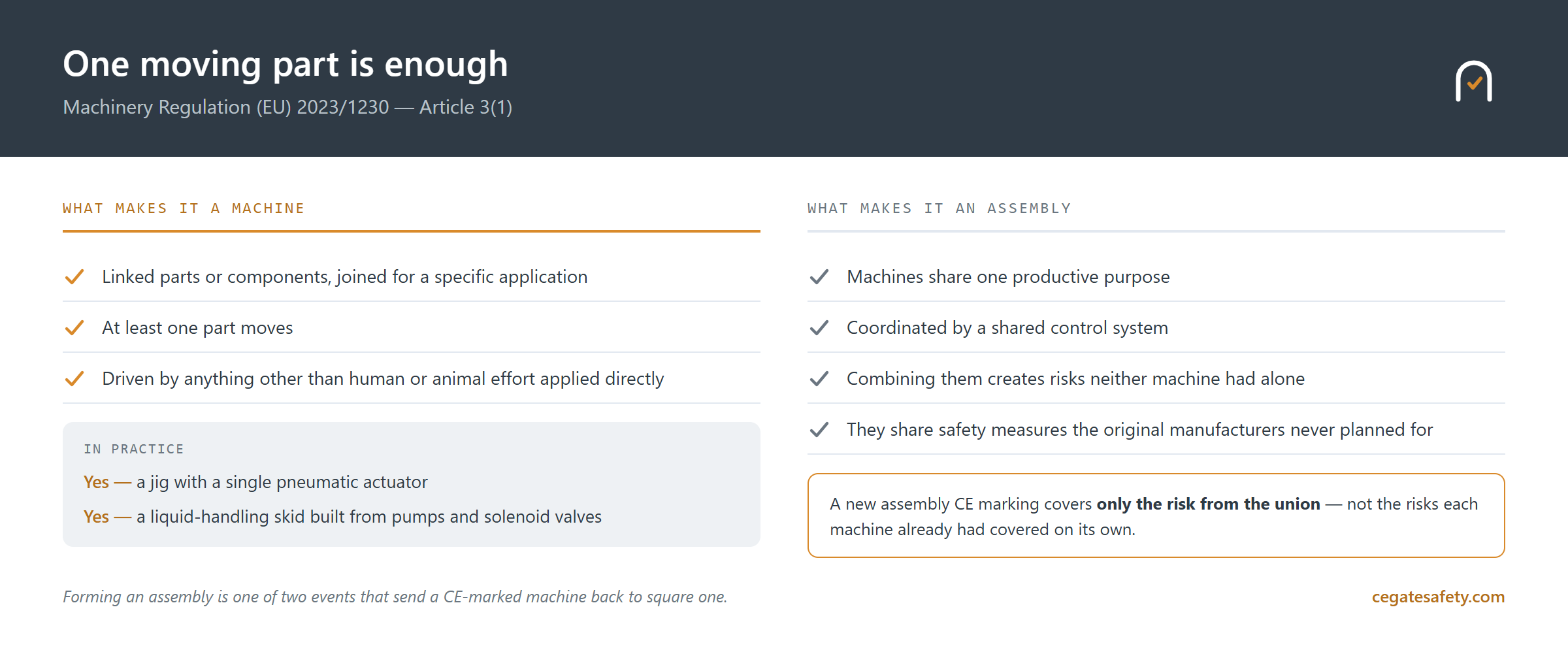
There's no threshold for complexity, no minimum number of parts, no exemption for equipment that looks more like a tool than a machine. A single-actuator jig — one pneumatic cylinder, a body to hold the part, nothing else moving — ticks all three boxes: linked components, one moving part, driven by compressed air rather than by hand. It's a machine, full stop, and it needs its own technical file, risk assessment and Declaration of Conformity, exactly as a five-axis machining centre does.
The same logic applies to systems that don't look like a single physical unit. A process skid for handling liquids — pumps, solenoid valves, piping, a frame to hold it together, built for a specific application — meets the same three conditions. It's a machine under the Regulation, not a collection of components that happen to be assembled together.
Article 3(1) covers a wider set of cases than point (a) alone. Point (b) is the same assembly missing only its on-site connections or its energy and motion sources — a machine shipped without its final hookups. Point (c) is a machine that can only function once mounted on a vehicle or installed in a building or structure. Point (e) covers manually powered lifting assemblies, where the only power source is direct human effort but the mechanism still counts as machinery. Point (f) is any of the above missing only the software upload for the specific application the manufacturer intended.
Where "assembly" comes from
Point (d) of the same article is worth reading on its own, because it's the definition that decides what happens when several CE-marked machines start working together. It covers assemblies of machinery referred to in points (a), (b) and (c), or of partly completed machinery, which, in order to achieve the same end, are arranged and controlled so that they function as an integral whole.
In practice, that turns into four questions worth asking about any group of machines working side by side. Do they share one productive purpose? Are they coordinated by a shared control system? Does combining them create risks that neither machine had on its own? And have they ended up sharing safety measures — a perimeter fence, a control panel, an emergency stop — that neither original manufacturer planned for?
Answer yes to those and you have an assembly, whether or not every individual machine already carries its own CE marking.
A worked example
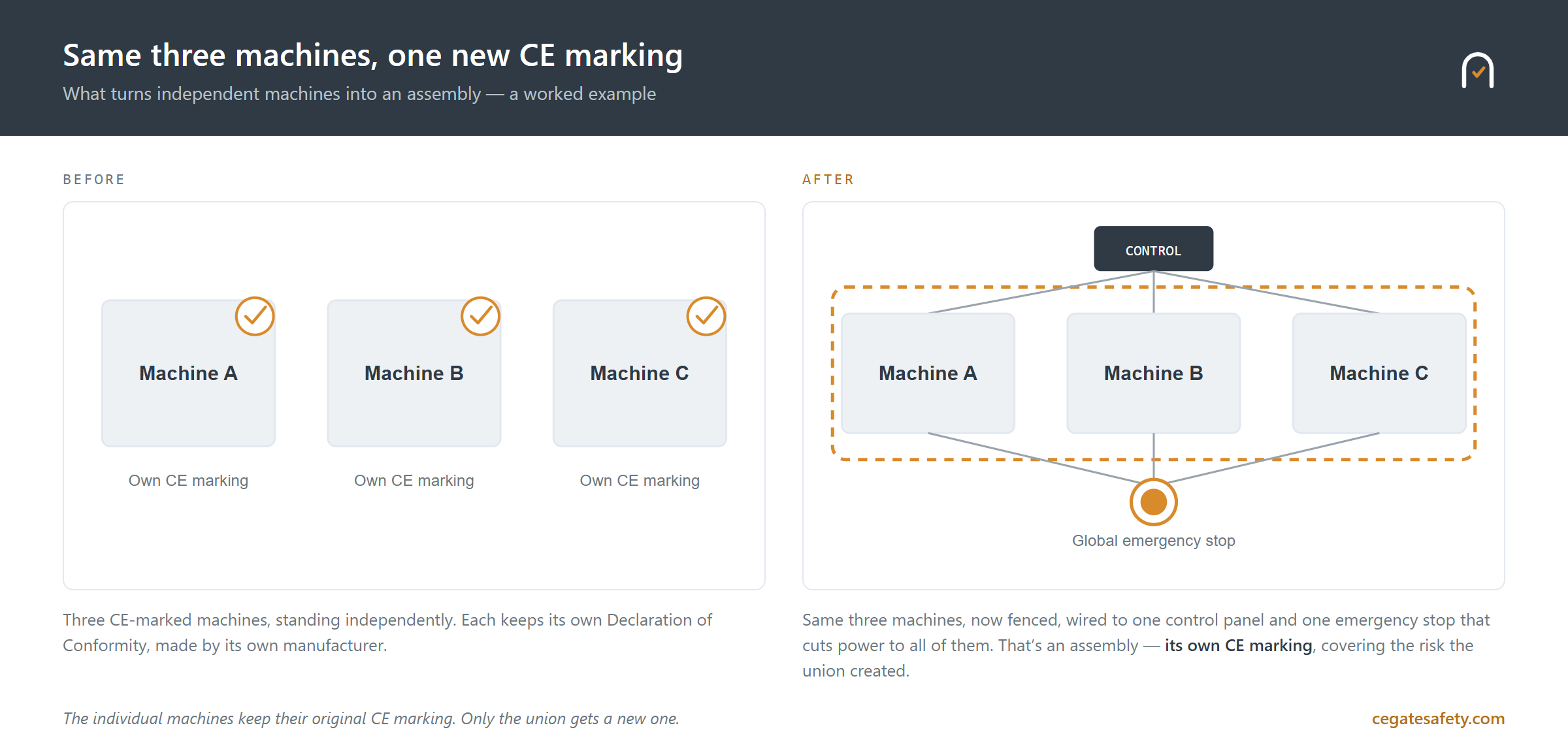
Take three machines, each already CE marked on its own, each with its own Declaration of Conformity from its own manufacturer. Standing independently, nothing about them changes. Put a shared perimeter fence around all three, wire them into one control panel, and add a single emergency stop that cuts power to every machine at once, and something has changed: the three machines now share a productive purpose, a control system, and a safety measure none of the original manufacturers designed for. That's an assembly, and whoever built it — the integrator, the end user, whoever specified the fence and the shared stop — takes on the manufacturer's obligations for it.
The detail worth holding on to: the assembly's CE marking only has to address the risk the union created. It doesn't reopen the risk assessment each machine's original manufacturer already carried out and marked. You're not redoing three technical files. You're building a fourth one, scoped to what changed when the three came together — the interfaces, the shared control logic, the combined emergency stop, the sequencing between machines.
Forming an assembly is one of two situations that send a CE-marked machine back to the start of the conformity process.
Why the Regulation being explicit here helps
None of this makes an assembly optional, and it never did — a group of machines that functions as an integral whole has always needed its own conformity assessment. What the Regulation does more clearly than before is bound the job: the new marking is about the risk from joining the machines, not a re-audit of what each one already had covered. That's a real practical difference when you're scoping a project, because it tells you where the assessment starts and where it stops.
Where this leaves you
Forming an assembly is one of two situations that require an already CE-marked machine to go through conformity again. The other is a substantial modification of a machine already in service. We'll cover that in the next article in this series, now that the Regulation finally draws a clear line around what counts as substantial and what doesn't.
We work regularly with manufacturers on exactly this kind of project — assemblies and process lines where several CE-marked machines end up sharing a control panel and a fence line, and someone has to work out what conformity actually requires for the group.
If you're not sure whether your setup already counts as an assembly, ask us for our overview of the main changes in the Regulation. Along with it, we'll send you the Readiness Checklist, so you can see where your CE marking stands in a few minutes.
Book a video call Request the checklist
References and sources
- Regulation (EU) 2023/1230 of the European Parliament and of the Council, Official Journal of the European Union, 29 June 2023 — Article 3(1).
- EUR-Lex legislative summary: Machinery Regulation.
This article is general information on EU machinery legislation, not legal advice on a specific product. Whether a given set-up is an assembly depends on how the machines are arranged, controlled and safeguarded in practice.